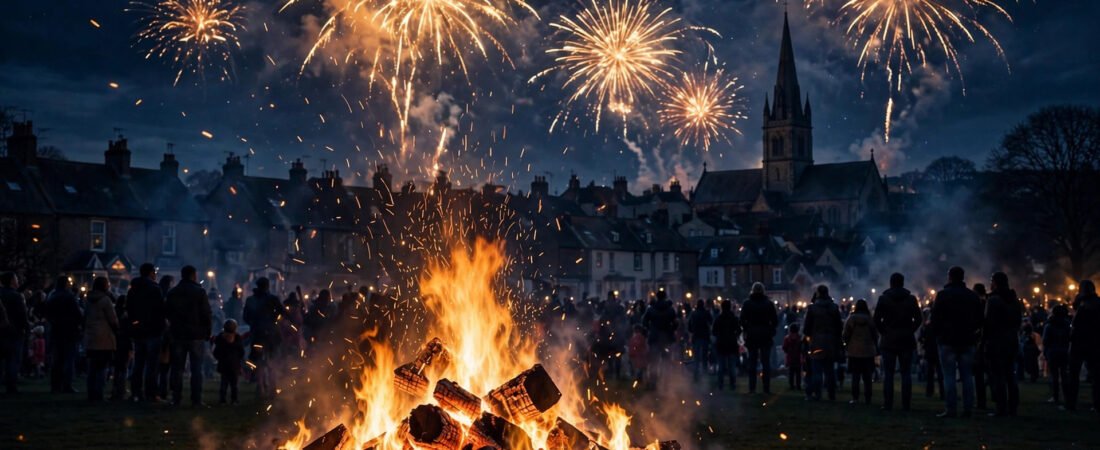
Every year on the 5th of November, skies across Britain light up with fireworks, fields glow with crackling bonfires, and crowds gather to remember one of the most dramatic nights in English history. Bonfire Night 2026 falls on Thursday, 5 November 2026 — and whether you’re heading to an organised display, building your first Guy, or simply curious why the country celebrates a failed 17th-century assassination, this guide has you covered.
In this article, you’ll find the true story of the Gunpowder Plot of 1605, how a day of national thanksgiving became Britain’s most fiery night, the traditions still going strong after more than 400 years, a look at Lewes — the self-styled bonfire capital of the world — and the essential fireworks safety rules to know before the night.
When Is Bonfire Night 2026?
Bonfire Night is always held on 5 November — it never moves. In 2026, 5 November falls on a Thursday, so expect the main celebrations to happen on the night itself, with many organised displays also running on the closest weekend (Saturday 7 and Sunday 8 November) to make the most of the occasion.
One point worth clearing up: Bonfire Night is not a bank holiday. Schools, businesses and public services operate normally on 5 November, and there is no extra day off attached to it — the celebrations take place in the evening, after the working day is done.
What Is Bonfire Night?
Bonfire Night, also known as Guy Fawkes Night or Fireworks Night, is an annual British commemoration held every 5 November. People gather around bonfires, watch firework displays, and traditionally burn an effigy — the “Guy” — on top of the fire.
Unlike Christmas or Easter, it’s not a religious festival, and unlike New Year’s Eve, it’s not a universal party. Bonfire Night is uniquely British: a four-century-old remembrance of the night Parliament — and the King — very nearly went up in flames.
The Gunpowder Plot: The True Story of 5 November 1605
To understand Bonfire Night, you have to go back to the early hours of 5 November 1605. Thirteen English Catholic conspirators, led by Robert Catesby, planned to blow up the House of Lords during the State Opening of Parliament. Their target was the Protestant King James I, along with the nobility, bishops and MPs gathered for the ceremony. The plan was to detonate 36 barrels of gunpowder hidden in a rented undercroft beneath the chamber, kill the king, and then kidnap his nine-year-old daughter Princess Elizabeth to install her as a Catholic queen.
The man chosen to guard the explosives and light the fuse was Guy Fawkes, a Catholic soldier with years of military experience fighting in the Spanish Netherlands. It was Fawkes — caught red-handed — who became the face of the plot, although he was not its leader.
The conspiracy unravelled thanks to an anonymous letter delivered on 26 October 1605 to Lord Monteagle, warning him to stay away from Parliament. Monteagle showed the letter to the authorities, and on the night of 4–5 November, searchers found Fawkes in the cellar beneath the House of Lords, surrounded by the gunpowder, calling himself “John Johnson”. He was arrested, tortured, and gave up the names of his fellow plotters. Most were killed or captured within days; the survivors were tried in January 1606 and executed.
News of the king’s survival spread across London, and people lit celebratory bonfires in the streets — the very first, spontaneous “bonfire night”. Parliament then made it official: in January 1606 it passed An Act for a Public Thanksgiving to Almighty God every Year on the Fifth Day of November, ordering an annual day of thanksgiving in every parish church in England.
From Day of Thanksgiving to Britain’s Fieriest Night
Within a few decades, “Gunpowder Treason Day” had become one of the most important dates in the English calendar. The religious commemoration was soon joined by popular festivities: bonfires, bell-ringing, fireworks and the burning of effigies of hate figures of the day. The event’s strong Protestant overtones made it a focus for anti-Catholic sentiment, with sermons, processions and the ritual burning of effigies of the Pope.
During the Commonwealth years (1649–1660), Oliver Cromwell banned the celebrations, but they returned with a vengeance after the Restoration of Charles II in 1660. Towards the end of the 18th century, children began making effigies of Guy Fawkes himself and begging for “a penny for the Guy” — a tradition many people still remember from their own childhoods.
By the 19th century, towns like Lewes and Guildford were famous for increasingly raucous — sometimes violent — celebrations, which gradually settled into the organised, family-friendly (if still spectacular) displays we know today. The anti-Catholic edge faded over time, and what remains is a national night of fire, fireworks and community celebration.
“Remember, Remember the Fifth of November”
No account of Bonfire Night is complete without the famous rhyme that has carried the story through the centuries:
“Remember, remember the fifth of November,
The gunpowder treason and plot;
I know of no reason why the gunpowder treason
Should ever be forgot.”
The rhyme is traditional — passed down by word of mouth for centuries — and its exact origins are lost to history. But its staying power is remarkable: more than 400 years on, most British schoolchildren can still recite those opening lines.
Bonfire Night 2026 Traditions
Modern Bonfire Night blends history with a good old-fashioned autumn night out. Here’s what the evening typically involves:
Bonfires and burning the Guy
Community bonfires remain the heart of the night. Many are topped with an effigy of Guy Fawkes — built from old clothes, straw and newspaper — which is ceremonially burned. In some towns the effigies are elaborate, topical figures rather than Fawkes himself.
Firework displays
From small garden shows to huge professional displays, fireworks are the signature sound and spectacle of 5 November. The biggest organised displays draw tens of thousands of spectators, and many events pair the fireworks with music, food stalls and funfairs.
Traditional Bonfire Night food
Bonfire Night has its own comforting menu, made for warming cold hands around a fire:
- Toffee apples — the classic Bonfire Night treat
- Parkin — a dark, sticky ginger oat cake, especially popular in Yorkshire and the North
- Treacle toffee (bonfire toffee) — hard, dark and dangerously delicious
- Baked potatoes and sausage rolls from food stalls
- Mulled wine, hot cider or hot chocolate for the grown-ups and children alike
Sparklers
Hand-held sparklers are a beloved Bonfire Night staple for children — but they’re not toys. Sparklers burn at extremely high temperatures, should always be held at arm’s length with gloves, placed in a bucket of water afterwards, and never given to children under five.
Lewes: The Bonfire Capital of the World
No town does Bonfire Night like Lewes, the market town in East Sussex that hosts the largest and most famous Bonfire Night celebrations in Britain. Seven local bonfire societies organise torchlit processions, burning crosses honouring the seventeen Protestant martyrs burned at the stake in Lewes during the 16th-century Marian Persecutions, spectacular firework displays and dramatic effigy burnings — drawing tens of thousands of visitors to a town of just 17,000 people.
Lewes Bonfire is always held on 5 November (unless the 5th falls on a Sunday, when it moves to Saturday the 4th). It’s a powerful, theatrical, genuinely unforgettable experience — but organisers actively discourage non-locals from travelling in on the night itself due to overcrowding and road closures. If you’re determined to go, arrive early, wear sturdy footwear, and expect a very late night. For most people, a local organised display is the better — and safer — way to enjoy the night.
Bonfire Night Across the UK
While Lewes takes the crown, organised Bonfire Night events happen in towns and cities across the country — from grand municipal displays in city parks to smaller community shows run by sports clubs and charities. Sussex alone has dozens of bonfire societies, each with its own colours, costumes and traditions, and similar events take place throughout England, Scotland and Wales.
The celebrations are essentially a British affair: although early colonists exported the custom to North America — where it was known as Pope Day — the tradition largely died out there with the American Revolution. Today, the biggest Bonfire Night events outside the UK are held by British expatriate communities.
Is Bonfire Night a Bank Holiday?
No. Bonfire Night is an observance, not a public holiday. The UK’s bank holidays are set by law, and 5 November isn’t one of them. Expect schools, offices and shops to run normally; the action all happens after dark.
Fireworks Safety and the Law
Bonfire Night is tremendous fun, but fireworks are explosives and deserve respect. The safest option is always to attend an organised display. If you’re having fireworks at home for Bonfire Night 2026, know the law and the Firework Code:
- Only buy fireworks marked UKCA or CE, from licensed retailers
- Only adults should buy, store and light fireworks
- Keep fireworks in a closed box, away from children and pets
- Read the instructions on each firework and follow them exactly
- Light fireworks at arm’s length with a taper, then stand well back
- Never return to a firework once it has been lit, and never throw fireworks or put them in your pocket
- Keep pets indoors and supervise children around fireworks
- It’s illegal to set off fireworks (including sparklers) in the street or other public places
For the full legal position on buying and using fireworks, see the official guidance on Fireworks: the law – GOV.UK. For more on the plot that started it all, the Royal Museums Greenwich’s guide to the history behind Bonfire Night is an excellent read.
One more safety note: before lighting a garden bonfire, always check the pile for hedgehogs and other wildlife that may have taken shelter inside, and never use petrol or paraffin to get it going.
Bonfire Night and Pets
Fireworks season is stressful for animals. Keep cats and dogs indoors on and around Bonfire Night 2026, close windows and curtains to muffle the noise, and create a cosy hiding place where your pet feels safe. Walk dogs earlier in the day, and consider leaving the radio on to mask the bangs.
Bonfire Night 2026: Frequently Asked Questions
What date is Bonfire Night 2026?
Bonfire Night 2026 is on Thursday, 5 November 2026. It is always observed on 5 November, whatever day of the week that falls on.
Why is Bonfire Night celebrated?
It commemorates the failure of the Gunpowder Plot of 1605, when Guy Fawkes and his fellow conspirators were caught trying to blow up the House of Lords with King James I inside. The celebrations began as spontaneous bonfires lit in relief at the king’s survival.
Who was Guy Fawkes?
Guy Fawkes was the explosives expert among the Gunpowder Plotters, caught guarding 36 barrels of gunpowder beneath Parliament on the night of 4–5 November 1605. The plot’s true leader was Robert Catesby, but Fawkes — the man found with the gunpowder — became the enduring symbol of the conspiracy.
Is 5 November a bank holiday in the UK?
No. Bonfire Night is not a bank holiday, and there is no day off attached to it. Schools, businesses and services operate normally.
Do Americans celebrate Bonfire Night?
Not really. Settlers once marked the date in the colonies as “Pope Day”, but the custom faded after the American Revolution. Bonfire Night remains an essentially British celebration, and Bonfire Night 2026 will be no exception.
Looking Ahead to the Festive Season
Bonfire Night marks the real start of the autumn-to-winter celebration season in Britain. As the embers cool, attention turns to Christmas — and our Christmas Day 2026 guide covers everything from its date and history to traditions on both sides of the Atlantic, with Christmas wishes and messages to get you in the spirit.
So this Bonfire Night 2026, wrap up warm, head to an organised display, enjoy the fireworks — and spare a thought for Guy Fawkes, the only man ever to enter Parliament with honest intentions. As the rhyme says: remember, remember.